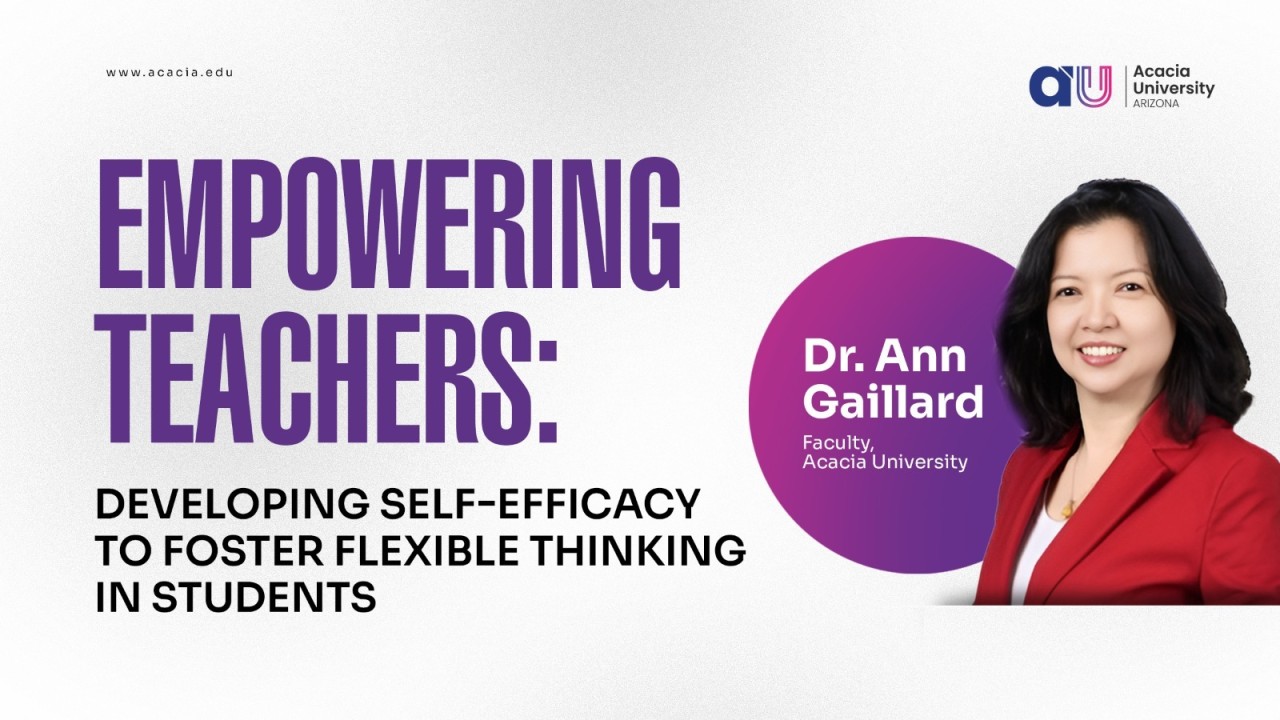
We are thrilled to share that Dr. Ann Gaillard’s book chapter, “Empowering Teachers Developing Self-Efficacy to Foster Flexible Thinking in Students,” will be released by IntechOpen soon. This work highlights how teachers can nurture flexible thinking — a skill essential for students to thrive in an uncertain, AI-driven world.
Dr. Gaillard explains the motivation behind her chapter:
“I wrote the book chapter ‘Empowering Teachers: Developing Self-Efficacy to Foster Flexible Thinking in Students’ because to survive and thrive in the age of AI, we must be able to think flexibly. This involves seeing issues from multiple perspectives, adapting to unfamiliar situations, and reframing problems rather than relying on fixed ways of thinking. As educators, we have the unique opportunity and responsibility to nurture our students’ flexible thinking skills to prepare them for an uncertain, complex world in which they must constantly adapt and readapt. However, this will only happen if teachers believe they can do so and feel confident in modeling and promoting flexible thinking. Various studies using Bandura’s self-efficacy theory (1977-1997) as a conceptual lens have shown that higher teacher self-efficacy is closely linked to improved student outcomes. My goal was to help teachers see themselves as capable of fostering flexible thinking so that their students are more likely to develop the skill.”
Her inspiration comes from observing teachers around the world:
“The inspiration for this work came from my experience in international education, where I have observed highly capable teachers who care deeply about creativity yet often struggle to translate that belief into regular classroom practice. Most of them spoke passionately about wanting their students to think ‘outside the box’ but felt limited by curriculum coverage demands, assessment pressures, or just the lack of a toolkit for encouraging creative thinking. I became interested in the gap between valuing creativity in theory and feeling able to foster it in practice. Flexible thinking, with its focus on shifting standpoints and exploring alternatives, seemed to sit right at the core of that gap.”
This chapter offers practical guidance for educators:
“What I hope educators take away from this chapter is, first, a renewed belief that flexible thinking is both essential and teachable. Since flexible thinking is a skill, not just an innate gift, it can be explicitly taught through specific, structured strategies. We may not need to wait for a small group of ‘naturally creative’ students — we can design learning engagements where all learners can practice flexibility. Second, I hope the chapter reassures educators that change can begin with small, practical steps: a warm-up prompt, a different framing of a question, or an enthusiastic invitation to consider an alternative viewpoint or solution.”
She emphasizes the power of small, meaningful moments in fostering growth:
“Finally, I hope readers see themselves seen in the teachers featured in the study — teachers who experiment, adjust, sometimes struggle, but ultimately become more confident in helping students think more flexibly. For example, in one reflective journal entry, a teacher participant described trying an alternative-viewpoint exercise for the first time. When a typically reserved student offered an unexpected perspective, the teacher recognized it as both the students willingness to take risks and validation of her efforts to create a classroom environment where students feel safe to experiment and express their ideas and opinions. This small yet meaningful moment encouraged the teacher to explore additional creative thinking routines. Growth often comes from these incremental steps. If this chapter inspires even a few teachers to try a new flexible-thinking strategy or to believe more in their own creative potential, then it will have fulfilled its purpose.”
�� Question for our readers: How do you encourage flexible thinking in your students or workplace? Share your thoughts in the comments!